Limited Memory AI: Easy Guide, Uses, and Real Examples
Published: 16 Feb 2026
Limited memory AI is one of the most common types of artificial intelligence used today, yet many people still find it confusing. How can a machine learn from the past without remembering everything? This is where limited memory AI stands out. Unlike basic AI systems that only react to the present, limited memory AI uses recent data to make better decisions.
It solves real problems like safer self-driving cars, better suggestions, and more accurate results. For example, a navigation app that adjusts routes based on recent traffic relies on limited-memory AI to work smoothly.
What is limited memory AI?
Limited memory AI is a type of artificial intelligence that can remember recent information to formulate better decisions. It does not store everything forever. Instead, it utilizes data for a short period to enhance its features. For example, a self-driving car uses fresh traffic data to decide when to brake or change lanes.
Key Features in Limited Memory AI
Learn from recent data: It looks at past information for a short period of time to produce decisions.
- Improves over time: As more examples are seen, the system improves.
- No long-term memory: It does not store all previous data permanently.
- Real-Time Decision Making: It uses current and recent data to act quickly.
- Practical in everyday life: used in apps, cars, recommendations, and more.
How AI with limited memory works
Limited memory AI processes information in a way that helps machines work more intelligently.
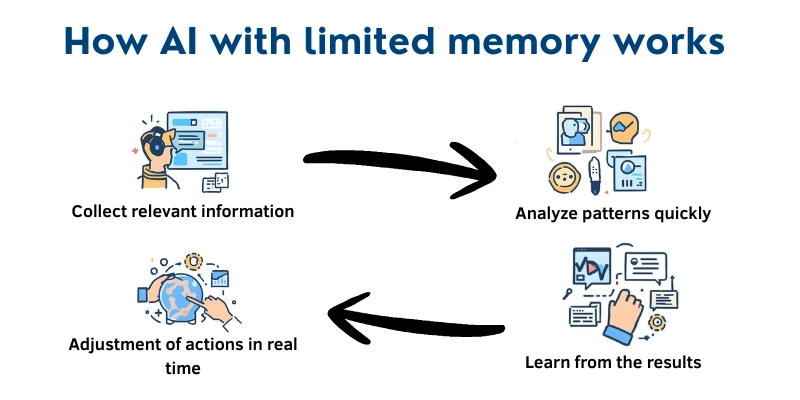
- Collect relevant information: AI focuses on the data that matters most to the task at hand. For example, stock trading AI looks at recent price movements rather than older market data.
- Analyze patterns quickly: It identifies trends or changes in short-term data to predict what may happen next.
- Adjustment of actions in real time: AI uses its analysis to make quick decisions, such as changing delivery routes or recommending a product.
- Learn from the results: After making decisions, note which actions worked best. This helps him to improve his future performance.
- Constant short-term updates: Instead of storing all previous information, AI only keeps recent data and removes older details to remain efficient.
Top Real-World Examples of Limited Memory AI
These are some simple ways limited-memory AI is used today:
- Self-driving cars: Cars that use recent road and traffic information to decide when to stop, turn, or slow down.
- Chatbots and virtual assistants: Online helpers that use your latest message to give the right answer.
- Recommendation systems: Websites that suggest products or videos based on what you recently searched or watched.
- Fraud detection systems: Bank systems that check recent payments to find unusual activity quickly.
Applications of Limited Memory AI
Limited-memory AI is used in many areas to help systems make better decisions using recent information.
Healthcare Systems
Limited-memory AI helps doctors find health problems early.
- It looks at recent test results and scans.
- It compares them with medical data to spot signs of disease.
- It can also check a patient’s recent reports to give better results.
Smart Navigation Apps
Limited memory AI helps drivers find faster routes.
- It studies recent traffic updates and road changes.
It suggests a better path if there is heavy traffic.- It uses fresh data to improve travel time.
Online Shopping Websites
Limited memory AI improves product suggestions.
- It looks at what a user searched or viewed recently.
- It shows products that match recent interest.
- It updates suggestions when user behavior changes.
Banking Security Systems
Limited memory AI helps keep accounts safe.
- It checks recent transactions and spending patterns.
- It quickly spots unusual activity.
- It alerts the user if something looks suspicious.
Advantages of Limited Memory AI
These are the major advantages of employing Limited Memory AI.
| Benefits of limited memory |
|---|
|
Disadvantages of Limited Memory
These are the major disadvantages of employing limited memory AI.
| Drawbacks of limited memory |
|---|
|
Limited Memory AI in Machine Learning
- Machine learning models: AI uses models to learn patterns from data.
- Training and testing data: It practices on some data (training) and checks results on other data (testing).
- Historical datasets: Look at past examples to make better predictions.
- Model updates: AI updates itself with new data to improve results.
Future of Limited Memory AI
- Expected improvements: AI will get smarter and faster.
- Better systems: they will handle more tasks and data easily.
- Improved data use: AI will make better use of recent and historical information.
- Advanced AI role: Limited memory AI may help in creating smarter AI types.
Tips to Understand Limited Memory AI Easily
- Think of it like short-term memory: it remembers recent information but not everything.
- Use real-life examples: look at apps, self-driving cars, or online shopping suggestions.
- Keep words simple: avoid hard technical terms; explain ideas in easy language.
- Focus on what it does: Notice how it uses recent data to make decisions.
- Compare with humans: Imagine how people remember only the last few things they saw or heard.
Conclusion
In this article, we’ve covered limited memory AI in detail. While it can make decisions faster and smarter, always remember it relies on recent data and can make mistakes if the data is wrong. My advice is to use it carefully and double-check important results, especially in areas like banking or healthcare. Start exploring limited memory AI safely and see how it can improve your daily tasks without risking errors.
FAQs: Limited Memory AI
Here are some important FAQs about Limited Memory AI
Limited memory AI is a type of artificial intelligence that remembers recent information to make better decisions. It does not keep all past data. It is used in apps, cars, and other smart systems.
Unlike reactive AI, limited memory AI can learn from recent data. It improves over time instead of only reacting to the current situation. But it still cannot remember everything forever.
No, it cannot think or feel like humans. It only uses short-term data to make decisions. It works best when following clear patterns or rules.
It is used in self-driving cars, online shopping suggestions, banking systems, and navigation apps. These systems use recent data to act smarter.
If the AI gets bad or incomplete data, it may make wrong decisions. Always double-check results in important areas like health or banking.
No, it only stores recent information temporarily. Long-term memory is not part of this type of AI.
It learns from the new data it sees. Each time it makes a decision, it adjusts its patterns slightly to do better next time.
Yes, mostly, but it depends on correct data and safe programming. Users should check important decisions, especially in health, finance, or driving applications.
Beginners often get confused because it remembers some data but not everything. It can also make mistakes if the data is bad. Start with simple apps to see how it works.
Yes, many apps already use it. For example, shopping suggestions, traffic apps, and banking alerts all use limited-memory AI to help you daily.





- Be Respectful
- Stay Relevant
- Stay Positive
- True Feedback
- Encourage Discussion
- Avoid Spamming
- No Fake News
- Don't Copy-Paste
- No Personal Attacks
- Be Respectful
- Stay Relevant
- Stay Positive
- True Feedback
- Encourage Discussion
- Avoid Spamming
- No Fake News
- Don't Copy-Paste
- No Personal Attacks
